Welcome to TVR WebMart
   RETURN TO THE PREVIOUS PAGE   
Tuscan
Tuscan Speed Six
Introduced 2000
Engine type/size 6/3966cc
0-60 (secs) 4.0
Max Speed (mph) 185

The new Tuscan is probably TVR's most significant car ever, but not for the reasons most people might think. The emphasis is not solely on the raw performance for which TVRs have always been justly renowned, but on making the car easy to use on a daily basis. It is something TVR Chairman Peter Wheeler describes as 'sophistication'. In the following pages, Wheeler and his team of engineers and designers explain where the new car fits into TVR's range, what they wanted from it, and how it was achieved. This is an exclusive view, from the people who know best, the people who have created the subject. Click, and climb aboard for the ride.

"THE NEW TUSCAN IS NOT ONLY TVR'S MOST DRAMATIC LOOKING ROAD CAR YET; IT'S ALSO THE FASTEST."

Steve Cropley, Autocar Magazine

"IT HAD TO BE AN EVERYDAY CAR"

TVR Chairman Peter Wheeler

According to the company’s chairman, the first and most important thing about TVR’s new Tuscan is that it had to be an everyday car. He already believes that the TVR range is more practical than many people imagine but for the first time there would be a real emphasis on that practicality as well as the performance which he says everybody takes for granted. "Unless you buy a Cerbera you have to be able to live with two seats," says Wheeler, "but if you can do that, then you should be able to use any TVR every day.

That is why it’s a front-engined, rear-drive layout. It’s the only configuration which will provide the comfort and the boot space. Two weeks touring for two people is the aim for all the two seaters. It’s where we set out in 1990."

Wheeler will admit though, that having focussed on things like accommodation and ease of use, it was possible to make changes.

Since 1990, there has been a steady evolution at TVR and although the Chimaera and Griffith still offer something well away from the mainstream - and the company has no plans to discontinue or change its staple products - the Tuscan is part of the next generation of very high performance TVRs. It is, says Wheeler, more a two seat development of the Cerbera, than an evolution of the Griffith or Chimaera.

But how is the Tuscan different. What are the specifics ? "For a start," says Wheeler, "it has a straight six engine. A large straight six, which is not fashionable these days but it works for us because we have a long bonnet and enough space to lean the engine over. A straight six is then a massive packaging advantage and it gave us a lot of options in laying out the car which weren’t available with the V8s. The narrower engine makes more room in the footwells for the driver and passenger’s feet and it allows us to make a nicer pedal layout. We can put the exhaust down the passenger side and, talking of which, there are also advantages in complying with legislation because we can place the catalysts close to the engine. That much has been forced on us a bit because the emissions regulations are getting tighter all the time and where we once had an advantage over the competition because we could put the catalysts in front of a V8 engine, we can’t get them any closer than they are. It will become harder and harder to make the Rover based engines meet those regulations

Besides, I’ve always liked the tradition of a twin cam straight six. Astons and Jaguars are a British tradition - although they didn’t use the layout for the reasons we have."

TVRs though have been associated exclusively with a V8 for a long time. Isn’t it a tradition you would like to maintain. "Having decided what extra space we needed in the Tuscan, we now can’t put a V8 in it even if we wanted to. It won’t fit. And we would have been most reluctant to scrap the central backbone chassis. It’s a great idea, and it has given the car a central strength and a structural integrity which is most important. I’ve seen convertibles that are based on a saloon type floorpan after they have been in a bad accident. They are usually broken in half or bent double and I just don’t think they are safe. The central backbone has been crash tested in the racing Tuscans more times than you can imagine and it has always stood up well. It must be the most crash tested chassis in the world.." What about the sophistication you mentioned ? "Nobody has really given us credit for the fact that TVRs ride extremely well for the sort of car they are. For a small company we put an awful lot of work into the dampers. In fact we are now working with another company to make what are effectively our own brand. But for the new Tuscan the main thing was to get the weight down. TVRs are not exactly heavy, but we wanted to focus on reducing weight at every stage of the design and construction. If we did that it would help both the handling and the performance which are still essential to TVR, but we could also use softer springs and control them with the dampers. That would improve the ride quality still further. It’s about controlling the weight of the wheels but I’ll let our chassis man Neill Anderson tell you about that"

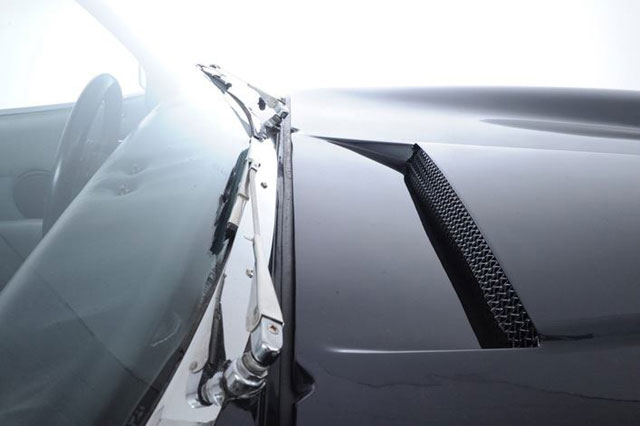
Anything else ? "A lot of little things which add up to a big whole. And there is the styling as well - which is another important part of TVR. There is always a good reason for everything we do, but usually the starting point for the styling is dictated by the engineering. I’d say it was form following function but I think someone else has already used that phrase. For instance, the straight six needed a long narrow bonnet bulge so we have made it a styling feature. Initially we tried it with vents to exhaust the cooling air but it didn’t look right. Then we came up with the idea of a fixed main engine cover and an opening one at the front. Audi have done something similar too, I believe. The ducts become the big dips in the bonnet and we were able to avoid having any holes to exhaust the hot air."

Tell us more about the styling. "We keep that simple too, believe it or not. Look at the sides of the car, there are no blisters or swages round the wheel arches. We keep it as straight as possible and the widest part is where the occupants are. That gives the biggest crumple zone. It doesn’t follow fashion because the form we have decided to adopt is different from most other people’s. It’s like bumpers. We were the first to do without them on the Griffith and now everyone’s doing it. We’ve also effectively done away with shutlines. It’s probably the last place people will look, but you’ll see that the shut lines run along the top of the car rather than anywhere on the side. Draw the shut lines and you’ve got the shape of the car, like a line ketch. We’ve never done that before but there’s a good reason. It gives us bigger bonnet and boot apertures. It’s easier to get the engine and gearbox out of the top rather than the bottom as you do in the Cerbera, and because the Tuscan is a Targa rather than a convertible we wanted to be absolutely sure that having taken off the roof and rear window, they would fit horizontally in the boot and leave room for luggage. And they do."

Have you ever considered making the bodies out of another material like steel or aluminium ? "Not seriously. Apart from the fact that the expense of tooling up for metal bodies wouldn’t make sense for the amount of cars we produce, those materials are too restrictive. Using composites allows us to make curves which you couldn’t have in steel because they couldn’t be stamped. If you look at any modern car, you’ll see that most of the steel bits are relatively straight. The tight curves, if there are any, are made in plastic. Composites give us freedom to make shapes we want to suit our styling, with the added benefit that more curves equals greater strength because they brace the structure. It is also such a versatile medium and it’s still evolving. We have used a new honeycomb construction for the Tuscan’s body, a sandwich which is our own variation. It’s stronger and lighter. We’ve saved about 30 kilos which is quite a high percentage of the total, but I’ll let Tuscan project manager Ben Lang tell you about that."

What about those little things. "Well, we’ve attempted to simplify the interior without losing all those little touches that people expect from us. The interior has fewer buttons than before but all the essential functions you need to operate the car except the heater and window winders are at eye level. You don’t have to take your eyes off the road to find them. We’ve made the doors open wider than before and we’ve made the sills lower so the car is easy to get in and more important, out. We’ve spent a lot of time on the seats as well. The seat belt is now attached to the seat rather than the back of the cockpit so you don’t have to reach right back for them and they won’t tangle when you reel them out. And the squab where you sit has a removable panel which can drop you down a couple of inches. We know our customers like to go to circuits, and one of the problems thay had was sitting in the car with the roof on, while wearing a helmet. You can’t have a seat height adjuster in a low car so this is a simple solution There’s also the instrument pod and the digital, need-to-know display which moves with the adjustable steering column so wherever you put the wheel you can see the instruments, but I’ll let Paul Harrop tell you about that. He designed it."

You’ve talked about strength in the chassis backbone. How much has safety featured in the whole design ? "A lot. We now believe there should be a rear roll cage as well as a front one. It was a safety feature we started with the Cerbera which was our first hardtop for a while and the first in a new line of very high performance TVRs. Oddly enough it isn’t the rollover accident that we are most worried about. It’s more the kind where a low car goes under the back of a lorry. But it’s difficult to have a rear roll cage in a convertible without looking as if it’s an afterthought and that was one of the reasons why we went for the Targa top with lift-out panels for the Tuscan because we can put a proper steel roll cage inside the Targa’s supports. A rear roll cage is also a useful place to hang the door beams. Then we can join the whole lot together with the door frames to form a protective cage. It’s for safety more than torsional stiffness, although the arrangement at the front with the long aluminium tube across the dash does help. I’ll let Chris Runciman tell you about that."

 
The heart of the car.

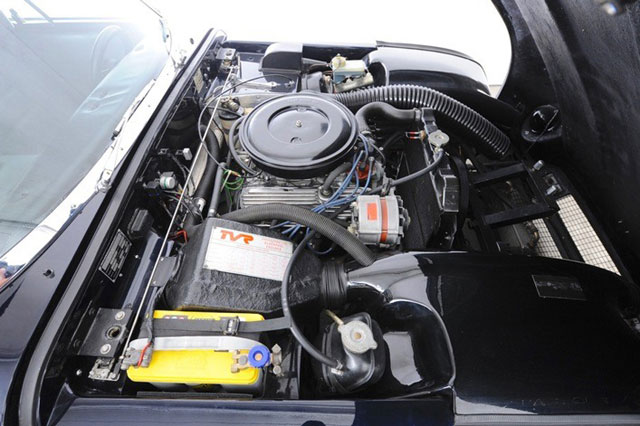
The heart of any car is its engine. The heart of a great car is a great engine. Imagine a Ferrari or Aston Martin with somebody else’s power unit. It might go as fast but it would no longer be the real thing. And as any sports car enthusiast knows, speed is not the only consideration. The way the engine delivers its power, the response and the sound as it works are as important as raw performance. These are essential ingredients in a car designed to give pleasure by the act of movement, and it was a need to personalise these ingredients that led TVR to make its own engines. Not only that, but to make a specific one to suit a different model. It is a massive task for a small company but an essential one for TVR’s future. With control of an engine’s characteristics as well as its performance, TVR could invest each model with the extra dimension that turns a good sports car into something unique. Added to which, the engine could wear the TVR badge, knowing it was part of that real thing.

The Tuscan’s Speed Six engine, with its six big cylinders running in-line along the car and with its pair of overhead camshafts driven by chains, is a return to the layout once traditional in British sports cars. A return to tradition but with the benefit of modern material and electronic technology. TVR engine design and development chief John Ravenscroft has overseen the development of all the company’s engines in recent year including the AJP V8 in the Cerbera and Tuscan race cars. Here he explains how that technology was applied to the engine in the new Tuscan road car.

"We’ve managed to make the six much the same as the V8 from the mid ranges upwards, but we think overall, its character suits the new car."

"We spend a lot of time on things like throttle response"

John Ravenscroft - engine design and development

 
The chassis and suspension.

TVRs have always been fast and they have always handled well. In recent years though the company has added a ride quality not always associated with high performance cars. The Tuscan is intended to take this one step further. A car that is perhaps the quickest TVR yet but one that rides better still. An "unusual car" according to Peter Wheeler. A TVR that is fitted with softer road springs than any in recent years, something that has only been possible because of the engineers’ dedication to reducing weight.

But, reducing weight brings its own engineering problems. If the car is too light then the wheels and tyres, and the brakes capable of handling and restraining the performance of something as fast as the Tuscan, will be relatively too heavy.

TVR chassis and suspension engineer Neill Anderson has overseen design and development of this department on all TVRs since the introduction of the Griffith nearly 10 years ago, and including the Cerbera that was introduced in 1995. Here, he explains what he and his team were looking for with the new Tuscan and how they tackled the ‘massive compromises’ that Chairman Peter Wheeler has deemed necessary.

"We would like a heavier body and a lighter wheel. A heavier body is a waste of energy and a lighter wheel is not strong enough"

"A Griffith says ‘thrash me down a country lane’. This car is not a racer. You should feel more of an air of sophistication as soon as you start to move.."

Neill Anderson, chassis and suspension

 
Special details.

We know that a new TVR interior is an interesting place. There is always something fresh, something different, a distinctive touch of style but always with a serious function. Like the flying buttress dash on the Cerbera and the suspended gauges inside the steering wheel, the central door knob on the Chimaera, the machined aluminium heater wheels, the keyless ignition sytem, the award winning hood design The list goes on The Tuscan’s cabin has its signatures even though it is designed to be simpler but there are other features which are less obvious but of which the engineers are just as proud.

Mark Dudley was the man responsible for the curved aluminium tube which runs across the dash. A structural essential or a bit of decoration. He will explain in a minute, and he will also tell you about the headlights that look like a styling feature, but didn’t start out as such, and the doorlocks which are essential to security ..

Chris Runciman designed the roll cages which were essential for the car’s strength and rigidity and the doors which open wider than before and tie the roll cages together. He also designed the Targa roof that fits in between.

"What looks like a simple styling feature is actually much lighter, easier to assemble and has more consistent quality"

Mark Dudley, TVR engineer

"A Targa bar usually makes a real howl once you take the roof off. I wish I could say we designed this one to be so quiet, but it just happened

Chris Runciman, TVR engineer

 
Instruments and electronics.

We know that a new TVR interior is an interesting place. There is always something fresh, something different, a distinctive touch of style but always with a serious function. Like the flying buttress dash on the Cerbera and the suspended gauges inside the steering wheel, the central door knob on the Chimaera, the machined aluminium heater wheels, the keyless ignition sytem, the award winning hood design The list goes on The Tuscan’s cabin has its signatures even though it is designed to be simpler but there are other features which are less obvious but of which the engineers are just as proud.

Mark Dudley was the man responsible for the curved aluminium tube which runs across the dash. A structural essential or a bit of decoration. He will explain in a minute, and he will also tell you about the headlights that look like a styling feature, but didn’t start out as such, and the doorlocks which are essential to security ..

Chris Runciman designed the roll cages which were essential for the car’s strength and rigidity and the doors which open wider than before and tie the roll cages together. He also designed the Targa roof that fits in between.

"What looks like a simple styling feature is actually much lighter, easier to assemble and has more consistent quality"

Mark Dudley, TVR engineer

"A Targa bar usually makes a real howl once you take the roof off. I wish I could say we designed this one to be so quiet, but it just happened

Chris Runciman, TVR engineer

 
Handling and performance.

These are the parts of TVR that most people take for granted. But already we know that the new Tuscan is next in a generation of ‘very high performance’ TVRs that began with the Cerbera. And the engineers and designers have all said that this car is meant to be different. That it performs well possibly better than any TVR to date but that it does so in a different way. That it is intended to be ‘sophisticated’ and easy to use. That it has a straight six engine, a big straight six engine, rather than the V8 with which TVR enthusiasts ahave become familiar.

Mark Hales is the only man to have won the Tuscan race series title more than once. He is also a respected author and motoring writer, a combination of racing and writing that led Peter Wheeler to ask for Hales’ comments on the new car. Wheeler wanted a candid assessment - the bad parts as well as the good - and because TVR owners like to take their pride and joy to the race circuit, the report should include a visit to Oulton Park.

The agreement between the two was simple. What was written would appear on this site. Good or bad

"The 0-60mph time which has become a sort of league table would not be topped by this particular TVR."

"in the real world, the car probably is quicker than the 420bhp, 4.5 litre Cerbera. It just won’t record the times at the test track."

Mark Hales, racer and writer
Tuscan
Tuscan S
Engine Capacity (cc) 3605 / 3996cc
0-60 (secs) 4.3 / 3.9
Max Speed (mph) 175 / 195+
On the Road Price £39,850 / £48,800
In April 2001 TVR announced the introduction of two new variants of the TVR Tuscan which replace the Tuscan Speed Six.

The first of these, simply designated the "Tuscan," features the same 3.6 litre engine as powers the Tamora. The reduced stroke of the 3.6 enables it to rev higher and makes it marginally more refined at the cost of a reduction in torque which means that it pushes out 350 bhp and 290 ft.lb. of torque.

The rest of the car is as the original Tuscan was with 16" wheels and such like. The car is £39,850 and it can be ordered now.

The second new variant is the Tuscan S which features the latest development of the 4 litre Speed Six engine which now pushes out 390 bhp. This model has revised suspension and brakes, 18" wheels, air conditioning, gas discharge headlamps and an upgraded trim level.

Externally, the car is differentiated by an unusual but extremely effective aerodynamics package which is necessitated by the car's top speed which is approaching 200 mph. The addition of the gurney has brought about the revised rear end styling treatment. The aerodynamics have resulted in the TVR Tuscan S joining the ranks of the very, very few road cars which actually have down force. The Tuscan S costs £48,800 and the first customer cars are already being delivered.

Source: The Official TVR web site.

TVR Tuscan II & Tuscan II S
Engine type/size V6 / 3996cc
0-60 (secs) 4.2
Max Speed (mph) 160+
On the Road Price ?

No other car engenders a sense of occasion quite like the Tuscan. Every journey in this spectacular car is unique and memorable, to which the attention it attracts, first by its low snarl and then by its anomalous design, gives glowing testimony.

The mark II Tuscan is the latest evolution of this legendary TVR. Stunning new lightweight composite bodywork. Luxurious new leather interior. Sophisticated new handling set-up. Same earth-shaking power-to-weight ratio.

Clothing one of the most substantial rollcages and chassis in the industry, the new bodywork has been designed to provide downforce for high-speed stability as well as head-turning looks. The new interior cossets its two occupants in seats trimmed in the finest hides, while there is room in the cavernous boot for two sets of golf clubs and luggage, even with the targa roof stowed.

With the newest development of the same straight six engine that propelled TVR to strong finishes in the grueling 24 hour race at Le Mans, the Tuscan out-performs the competition, while suspension geometry, chassis and steering developments make it even easier to drive than ever before.

Every wave and scoop in the curvaceous body of the Tuscan serves a practical purpose: the outlets in the bonnet serve as low pressure exits for the hot air from the radiator; the gurney above the bootlid and the splitter under the front grille jointly create downforce over both axles; and the low, swooping lip cuts through the air to help the Tuscan reach its ultimate potential.

The range-topping Tuscan S features a handling set-up and a phenomenal 380 bhp four-litre engine aimed more at the most sporting drivers, as well as a motorsport derived aerodynamic package. The S version rockets to 60 mph in just 3.8 seconds and continues to storm to a break-neck top speed.

    Engine
  • Displacement: 3996cc
  • 6-cylinder inline alloy engine with 4 valves per cylinder and dry sump lubrication
  • Max Power: 365 bhp @ 7000 rpm
  • (Tuscan S - 380 bhp @ 7000 rpm)
  • Max Torque: 290 ft.lbs @ 5500 rpm
  • (Tuscan S - 310 ft.lbs @ 5250 rpm)
    Suspension All round independent – double wishbones and coil over gas dampers assisted by anti-roll bars
    Steering
  • Power assisted rack and pinion
    Brakes
  • Front: 304mm (Tuscan S - 322mm) ventilated disc brakes with 4 piston alloy callipers
  • Rear: 282mm (Tuscan S - 298mm) ventilated disc brakes with single piston sliding callipers
    Wheels and tyres
  • Front: 18 inch aluminium alloy wheels, 225/35 ZR18 tyres
  • Rear: 18 inch aluminium alloy wheels, 235/40 ZR18 tyres
    Dimensions and weight
  • Length overall: 4235 mm
  • Width overall (inc. mirrors): 1810 mm
  • Height overall: 1200 mm
  • Ground clearance: 102 mm
  • Weight: 1100 kg
    Performance data
  • 0 to 60 mph: 4.2 seconds (Tuscan S - 3.8 seconds)
  • 0 to 100 mph: 9.0 seconds (Tuscan S - 8.1 seconds)
  • Max Speed: +160 mph

Source: The Official TVR web site.

   RETURN TO THE PREVIOUS PAGE